Build a Mini vLLM: Paged KV Cache and Continuous Batching From Scratch

Serving an LLM is a memory-management problem wearing a deep-learning costume. The KV cache — not the weights — decides how many requests fit on a GPU, and how you schedule requests decides how much of the hardware you waste. vLLM reframed both with two ideas borrowed from operating systems:

  1. PagedAttention (Kwon et al., SOSP 2023) — store each sequence’s KV cache in small non-contiguous blocks (like virtual-memory pages) instead of one big reserved slab, eliminating the 60–80% memory waste of naive serving.
  2. Continuous batching — admit and retire requests at token granularity instead of waiting for a whole batch to finish, so the batch stays full and decode hardware stays busy.

This chapter builds both, from scratch, in ~150 lines on this repo’s transformer layers — with a correctness proof against contiguous attention, measured memory waste, measured batch occupancy, and real preemption when the block pool runs dry.

Concepts covered

# Concept Section
1 Why the KV cache dominates serving memory §1
2 Block pool + block tables (paged KV cache) §2
3 PagedAttention, verified against contiguous attention §3–4
4 The engine: admission, decode, retirement §5
5 Memory waste: reserved vs allocated vs used §6
6 Static vs continuous batching (occupancy, steps) §7
7 Preemption by recompute when memory runs out §8
Tip📺 Video companion

Fast LLM Serving with vLLM and PagedAttention (Anyscale) is the vLLM authors presenting exactly these two ideas; for the memory-math background first, see The KV Cache: Memory Usage in Transformers (Efficient NLP) — more in Videos.

Note🎯 Goal

Build vLLM’s two core ideas from scratch: a paged KV cache with block tables, and a continuous-batching engine with preemption.

🏗️ Chapter milestone: M13 — the finale: serve your trained model through this engine — the exercise at the end of this chapter; see The Project.

Tip⏱️ Sessions S4.1–S4.6

Six sessions: S4.1–S4.2 build the paged cache and scheduler with the chapter; S4.3–S4.6 are the finale 🏗️ M13a–d — your model through your engine. Cards, prerequisites, and done-when tests: the Session Guide.

Open in Colab

Runs on CPU — the model is tiny (untrained, seeded) because the lessons here are about memory and scheduling, not model quality.

Setup
# Setup — works from a repo checkout (via ../src) or standalone on Colab
import sys
sys.path.insert(0, '../src')
try:
    import ai_playground  # noqa: F401
except ImportError:
    %pip install -q git+https://github.com/ggreg/ai_playground.git

%config InlineBackend.figure_format = 'retina'
from ai_playground.plotting import apply_plot_style
apply_plot_style()

1. The memory problem

During decode, every generated token needs the keys and values of every previous token in every layer — that’s the KV cache. Per token it costs 2 (K and V) x n_layers x n_kv_heads x head_dim x bytes:

Model Per token 2,048-token sequence 16 such sequences
LLaMA-7B (fp16, MHA) 512 KB 1.0 GB 16 GB — a whole A100-40GB is half cache
LLaMA-2-70B (fp16, GQA 8) 320 KB 0.7 GB 10.5 GB

Naive serving reserves each request’s worst case (prompt + max_new_tokens) as one contiguous slab up front. Most requests stop early, so most of that reservation is never touched — the vLLM paper measured only 20–38% of KV memory holding actual token state in existing systems. Fewer requests fit, throughput dies. Let’s reproduce the problem, then fix it.

Code
import math, time
from collections import deque
from dataclasses import dataclass, field

import matplotlib.pyplot as plt
import numpy as np
import torch
import torch.nn as nn
import torch.nn.functional as F

from ai_playground.models.layers import RMSNorm, SwiGLU, apply_rope, precompute_rope_frequencies

torch.manual_seed(0)

DIM, N_LAYERS, N_HEADS, N_KV, HEAD_DIM = 128, 4, 8, 4, 16
VOCAB, HIDDEN, MAX_LEN = 256, 256, 512
REP = N_HEADS // N_KV  # GQA: each KV head serves 2 query heads


class MiniLayer(nn.Module):
    def __init__(self):
        super().__init__()
        self.attn_norm = RMSNorm(DIM)
        self.wq = nn.Linear(DIM, N_HEADS * HEAD_DIM, bias=False)
        self.wk = nn.Linear(DIM, N_KV * HEAD_DIM, bias=False)
        self.wv = nn.Linear(DIM, N_KV * HEAD_DIM, bias=False)
        self.wo = nn.Linear(N_HEADS * HEAD_DIM, DIM, bias=False)
        self.ffn_norm = RMSNorm(DIM)
        self.ffn = SwiGLU(DIM, HIDDEN)


class MiniModel(nn.Module):
    """A LLaMA-style decoder small enough to serve on CPU. Untrained on
    purpose: paging and scheduling are about *where bytes live*, not what
    the model says."""

    def __init__(self):
        super().__init__()
        self.embed = nn.Embedding(VOCAB, DIM)
        self.layers = nn.ModuleList(MiniLayer() for _ in range(N_LAYERS))
        self.norm = RMSNorm(DIM)
        self.head = nn.Linear(DIM, VOCAB, bias=False)
        self.register_buffer("freqs", precompute_rope_frequencies(HEAD_DIM, MAX_LEN))


model = MiniModel().eval()
n_params = sum(p.numel() for p in model.parameters())
kv_per_token = 2 * N_LAYERS * N_KV * HEAD_DIM * 4  # fp32 bytes
print(f'{n_params:,} params; KV cache: {kv_per_token} bytes/token '
      f'({kv_per_token * MAX_LEN / 1e3:.0f} kB for one full-length sequence)')
656,512 params; KV cache: 2048 bytes/token (1049 kB for one full-length sequence)

2. The paged KV cache

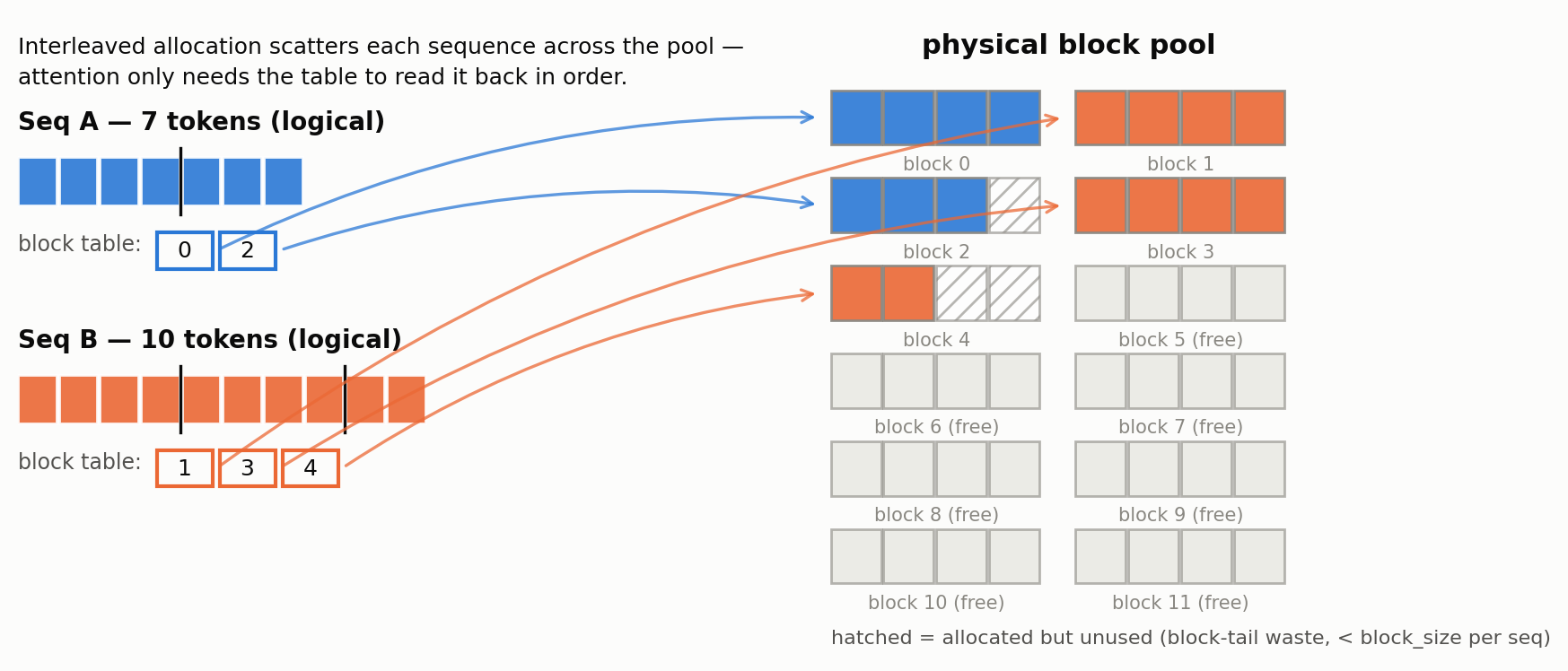
Instead of one slab per sequence, keep one global pool of fixed-size blocks (16 tokens each here; vLLM’s default) plus a block table per sequence mapping logical position → physical block. Allocation is on-demand — a sequence holds exactly ceil(len / block_size) blocks, so the only waste is the tail of its last block (< 16 tokens, vs. hundreds for a slab).

Code
BLOCK = 16  # tokens per block


class KVPool:
    """The physical memory: all blocks for all sequences, all layers."""

    def __init__(self, num_blocks):
        shape = (N_LAYERS, num_blocks, BLOCK, N_KV, HEAD_DIM)
        self.k = torch.zeros(shape)
        self.v = torch.zeros(shape)
        self.num_blocks = num_blocks


class BlockManager:
    """The virtual-memory side: free list + per-sequence block tables."""

    def __init__(self, num_blocks):
        self.num_blocks = num_blocks
        self.free = list(range(num_blocks))
        self.table = {}   # seq id -> [physical block ids]
        self.length = {}  # seq id -> tokens written

    def can_admit(self, n_tokens):
        return len(self.free) >= math.ceil((n_tokens + 1) / BLOCK)

    def start(self, sid):
        self.table[sid], self.length[sid] = [], 0

    def append_slot(self, sid):
        """Reserve the slot for this sequence's next token -> (block, offset)."""
        pos = self.length[sid]
        if pos % BLOCK == 0:  # last block full: page in a new one
            if not self.free:
                raise MemoryError("block pool exhausted")
            self.table[sid].append(self.free.pop())
        self.length[sid] = pos + 1
        return self.table[sid][pos // BLOCK], pos % BLOCK

    def release(self, sid):
        self.free.extend(self.table.pop(sid))
        del self.length[sid]

    @property
    def allocated_tokens(self):  # slots owned (incl. block-tail waste)
        return (self.num_blocks - len(self.free)) * BLOCK

    @property
    def used_tokens(self):  # slots actually holding a token
        return sum(self.length.values())
Show diagram code
# The picture worth the whole section: two sequences allocated interleaved
# (as happens during real decode), so their blocks scatter across the pool.
# Small block size (4) purely for legibility — the engine uses 16.
DB, N_POOL = 4, 12
seq_lens = {'Seq A': 7, 'Seq B': 10}
colors = {'Seq A': 'C0', 'Seq B': 'C5'}

free, tables, counts = list(range(N_POOL)), {}, dict.fromkeys(seq_lens, 0)
while any(counts[s] < n for s, n in seq_lens.items()):   # same rule as BlockManager
    for s, n in seq_lens.items():
        if counts[s] < n:
            if counts[s] % DB == 0:
                tables.setdefault(s, []).append(free.pop(0))
            counts[s] += 1

fig, ax = plt.subplots(figsize=(9.5, 4.6))
ax.set_xlim(0, 20); ax.set_ylim(-0.5, 10); ax.axis('off'); ax.grid(False)

block_xy = {}
ax.text(15.9, 9.4, 'physical block pool', ha='center', fontsize=11, fontweight='semibold')
for b in range(N_POOL):
    bx, by = 12.3 + (b % 2) * 3.7, 7.9 - (b // 2) * 1.45
    block_xy[b] = (bx, by)
    owner = next((s for s, t in tables.items() if b in t), None)
    for i in range(DB):
        used = owner is not None and tables[owner].index(b) * DB + i < seq_lens[owner]
        fc = colors[owner] if used else ('white' if owner else '#e1e0d9')
        hatch = '///' if (owner and not used) else None
        ax.add_patch(plt.Rectangle((bx + i * 0.8, by), 0.76, 0.9, facecolor=fc,
                                   edgecolor='#898781', hatch=hatch, alpha=0.9 if used else 0.6))
    label = f'block {b}' if owner else f'block {b} (free)'
    ax.text(bx + 1.6, by - 0.42, label, ha='center', fontsize=7.5, color='#898781')

for row, (s, n) in enumerate(seq_lens.items()):
    y = 6.9 - row * 3.6
    ax.text(0, y + 1.25, f'{s}{n} tokens (logical)', fontsize=10, fontweight='semibold')
    for i in range(n):  # logical token strip, block boundaries marked
        ax.add_patch(plt.Rectangle((0 + i * 0.62, y), 0.58, 0.8,
                                   facecolor=colors[s], edgecolor='white', alpha=0.9))
        if i % DB == 0 and i:
            ax.plot([i * 0.62 - 0.02] * 2, [y - 0.15, y + 0.95], color='#0b0b0b', lw=1.2)
    ax.text(0, y - 0.75, 'block table:', fontsize=8.5, color='#52514e')
    for j, b in enumerate(tables[s]):
        tx = 2.1 + j * 0.95
        ax.add_patch(plt.Rectangle((tx, y - 1.05), 0.85, 0.6, facecolor='none',
                                   edgecolor=colors[s], lw=1.5))
        ax.text(tx + 0.42, y - 0.76, str(b), ha='center', va='center', fontsize=9)
        bx, by = block_xy[b]
        ax.annotate('', xy=(bx - 0.15, by + 0.45), xytext=(tx + 0.9, y - 0.75),
                    arrowprops=dict(arrowstyle='->', color=colors[s], lw=1.2, alpha=0.75,
                                    connectionstyle='arc3,rad=-0.12'))

ax.text(0, 9.4, 'Interleaved allocation scatters each sequence across the pool —', fontsize=9)
ax.text(0, 8.9, 'attention only needs the table to read it back in order.', fontsize=9)
ax.text(12.3, -0.35, 'hatched = allocated but unused (block-tail waste, < block_size per seq)',
        fontsize=8, color='#52514e')
plt.show()

3. PagedAttention

Attention doesn’t care that K and V are scattered across blocks — it just needs them gathered in logical order. That gather through the block table is PagedAttention (the real kernel fuses it; we let PyTorch do it legibly):

Code
def gather_kv(pool, bm, sid, layer):
    """Block table -> (seq_len, n_kv, head_dim) in logical order."""
    blocks = bm.table[sid]
    k = pool.k[layer, blocks].reshape(-1, N_KV, HEAD_DIM)[: bm.length[sid]]
    v = pool.v[layer, blocks].reshape(-1, N_KV, HEAD_DIM)[: bm.length[sid]]
    return k, v


def paged_attention(q, k, v):
    """One query token against a gathered cache. q: (H, hd); k, v: (L, KV, hd)."""
    k = k.repeat_interleave(REP, dim=1)  # GQA: expand KV heads to query heads
    v = v.repeat_interleave(REP, dim=1)
    scores = torch.einsum("hd,lhd->hl", q, k) / math.sqrt(HEAD_DIM)
    return torch.einsum("hl,lhd->hd", scores.softmax(-1), v)


def rope_at(x, positions):
    """apply_rope for a batch of single tokens at *different* positions."""
    xc = torch.view_as_complex(x.float().reshape(*x.shape[:-1], -1, 2))
    freqs = model.freqs[positions].unsqueeze(1)  # (B, 1, hd/2) -> broadcast over heads
    return torch.view_as_real(xc * freqs).flatten(-2).type_as(x)

4. Two forward paths, one set of weights — and a proof they agree

The contiguous path recomputes the whole sequence every step (the reference: simple, obviously correct, O(n²) wasteful). The paged path does prefill once (writing K/V into blocks) then decodes one token at a time against the gathered cache. If paging is implemented right, they must produce identical tokens:

Code
@torch.no_grad()
def forward_full(tokens):
    """Reference: full causal forward over the whole sequence -> logits (T, vocab)."""
    T = tokens.numel()
    x = model.embed(tokens)[None]
    mask = torch.full((T, T), float("-inf")).triu(1)
    for lyr in model.layers:
        h = lyr.attn_norm(x)
        q = lyr.wq(h).view(1, T, N_HEADS, HEAD_DIM)
        k = lyr.wk(h).view(1, T, N_KV, HEAD_DIM)
        v = lyr.wv(h).view(1, T, N_KV, HEAD_DIM)
        q, k = apply_rope(q, k, model.freqs)
        k = k.repeat_interleave(REP, dim=2)
        v = v.repeat_interleave(REP, dim=2)
        scores = torch.einsum("bqhd,bkhd->bhqk", q, k) / math.sqrt(HEAD_DIM) + mask
        att = torch.einsum("bhqk,bkhd->bqhd", scores.softmax(-1), v)
        x = x + lyr.wo(att.reshape(1, T, -1))
        x = x + lyr.ffn(lyr.ffn_norm(x))
    return model.head(model.norm(x))[0]


@torch.no_grad()
def prefill(pool, bm, sid, tokens):
    """Process the prompt once, writing K/V into this sequence's blocks."""
    T = tokens.numel()
    x = model.embed(tokens)[None]
    mask = torch.full((T, T), float("-inf")).triu(1)
    slots = [bm.append_slot(sid) for _ in range(T)]
    for li, lyr in enumerate(model.layers):
        h = lyr.attn_norm(x)
        q = lyr.wq(h).view(1, T, N_HEADS, HEAD_DIM)
        k = lyr.wk(h).view(1, T, N_KV, HEAD_DIM)
        v = lyr.wv(h).view(1, T, N_KV, HEAD_DIM)
        q, k = apply_rope(q, k, model.freqs)
        for t, (blk, off) in enumerate(slots):  # scatter into the pool
            pool.k[li, blk, off] = k[0, t]
            pool.v[li, blk, off] = v[0, t]
        kr = k.repeat_interleave(REP, dim=2)
        vr = v.repeat_interleave(REP, dim=2)
        scores = torch.einsum("bqhd,bkhd->bhqk", q, kr) / math.sqrt(HEAD_DIM) + mask
        att = torch.einsum("bhqk,bkhd->bqhd", scores.softmax(-1), vr)
        x = x + lyr.wo(att.reshape(1, T, -1))
        x = x + lyr.ffn(lyr.ffn_norm(x))
    return model.head(model.norm(x))[0, -1]  # logits for the next token


@torch.no_grad()
def decode_step(pool, bm, sids, last_tokens):
    """One new token for every running sequence. Projections and FFN batch
    across sequences; only the attention gather is per-sequence (the ragged
    part — exactly what vLLM's custom kernel handles)."""
    positions = torch.tensor([bm.length[s] for s in sids])  # position of the new token
    slots = [bm.append_slot(s) for s in sids]
    x = model.embed(last_tokens)  # (B, dim)
    for li, lyr in enumerate(model.layers):
        h = lyr.attn_norm(x)
        q = rope_at(lyr.wq(h).view(-1, N_HEADS, HEAD_DIM), positions)
        k = rope_at(lyr.wk(h).view(-1, N_KV, HEAD_DIM), positions)
        v = lyr.wv(h).view(-1, N_KV, HEAD_DIM)
        outs = []
        for b, sid in enumerate(sids):
            blk, off = slots[b]
            pool.k[li, blk, off] = k[b]
            pool.v[li, blk, off] = v[b]
            kk, vv = gather_kv(pool, bm, sid, li)
            outs.append(paged_attention(q[b], kk, vv))
        x = x + lyr.wo(torch.stack(outs).reshape(len(sids), -1))
        x = x + lyr.ffn(lyr.ffn_norm(x))
    return model.head(model.norm(x))  # (B, vocab)


# --- the proof ---
prompts = [torch.randint(0, VOCAB, (n,)) for n in (11, 23, 37)]
NEW = 20

ref_outputs = []
for p in prompts:
    toks = p.clone()
    for _ in range(NEW):
        toks = torch.cat([toks, forward_full(toks)[-1].argmax().view(1)])
    ref_outputs.append(toks[len(p):].tolist())

pool, bm = KVPool(64), BlockManager(64)
paged_outputs = []
for i, p in enumerate(prompts):
    bm.start(i)
    last = prefill(pool, bm, i, p).argmax().view(1)
    out = [last.item()]
    for _ in range(NEW - 1):
        last = decode_step(pool, bm, [i], last)[0].argmax().view(1)
        out.append(last.item())
    paged_outputs.append(out)
    bm.release(i)

assert paged_outputs == ref_outputs
print(f'paged == contiguous for {len(prompts)} sequences x {NEW} tokens ✓')
print('sample:', paged_outputs[0][:8], '...')
paged == contiguous for 3 sequences x 20 tokens ✓
sample: [241, 43, 37, 163, 174, 3, 232, 7] ...

Identical tokens — with the reference recomputing everything every step while the paged path touches only one new token per step. (Same trade the repo’s inference/generate.py makes with its contiguous cache; paging changes where the cache lives, not what attention computes.)

5. The engine

Requests arrive, get admitted while blocks last, decode in lockstep, and leave. Two policies, one flag:

  • static: admit a batch only when the previous one has fully drained — the batch shrinks as short requests finish, and stragglers run nearly alone.
  • continuous: refill the batch every step, at token granularity.
Code
@dataclass
class Request:
    rid: int
    prompt: torch.Tensor
    max_new: int             # the requested cap — what a naive server must reserve
    stop_after: int          # where generation actually stops (simulated EOS)
    out: list = field(default_factory=list)


class MiniVLLM:
    def __init__(self, num_blocks, max_batch=8, continuous=True):
        self.pool, self.bm = KVPool(num_blocks), BlockManager(num_blocks)
        self.max_batch, self.continuous = max_batch, continuous
        self.waiting, self.running, self.done = deque(), [], []
        self.last = {}
        self.preemptions = 0
        self.history = []  # (occupancy, naive_reserved, allocated, used) per step

    def submit(self, reqs):
        self.waiting.extend(reqs)

    def _admit(self):
        while (self.waiting and len(self.running) < self.max_batch
               and self.bm.can_admit(len(self.waiting[0].prompt))):
            r = self.waiting.popleft()
            self.bm.start(r.rid)
            self.last[r.rid] = prefill(self.pool, self.bm, r.rid, r.prompt).argmax().view(1)
            r.out.append(self.last[r.rid].item())
            self.running.append(r)

    def _preempt_youngest(self):
        """vLLM-style recompute preemption: evict the newest request, free its
        blocks, requeue it with its generated tokens folded into the prompt."""
        r = self.running.pop()
        self.bm.release(r.rid)
        del self.last[r.rid]
        r.prompt = torch.cat([r.prompt, torch.tensor(r.out, dtype=torch.long)])
        self.waiting.appendleft(r)
        self.preemptions += 1

    def step(self):
        if self.continuous or not self.running:
            self._admit()
        # every running seq needs one slot this step; preempt until that's guaranteed
        while self.running:
            need = sum(1 for r in self.running if self.bm.length[r.rid] % BLOCK == 0)
            if need <= len(self.bm.free):
                break
            self._preempt_youngest()
        if not self.running:
            return
        sids = [r.rid for r in self.running]
        last = torch.cat([self.last[s] for s in sids])
        logits = decode_step(self.pool, self.bm, sids, last)
        finished = []
        for b, r in enumerate(self.running):
            tok = logits[b].argmax().view(1)
            self.last[r.rid] = tok
            r.out.append(tok.item())
            if len(r.out) >= r.stop_after:
                finished.append(r)
        for r in finished:
            self.running.remove(r)
            self.bm.release(r.rid)
            del self.last[r.rid]
            self.done.append(r)
        naive = sum(len(r.prompt) + r.max_new for r in self.running)
        self.history.append((len(self.running), naive,
                             self.bm.allocated_tokens, self.bm.used_tokens))

    def run(self):
        while self.waiting or self.running:
            self.step()
        return self


def make_workload(n=24, seed=7):
    rng = np.random.default_rng(seed)
    reqs = []
    for i in range(n):
        max_new = int(rng.integers(48, 80))
        reqs.append(Request(rid=i,
                            prompt=torch.randint(0, VOCAB, (int(rng.integers(8, 48)),)),
                            max_new=max_new,
                            stop_after=int(rng.integers(5, max_new))))
    return reqs

6. Memory: reserved vs allocated vs used

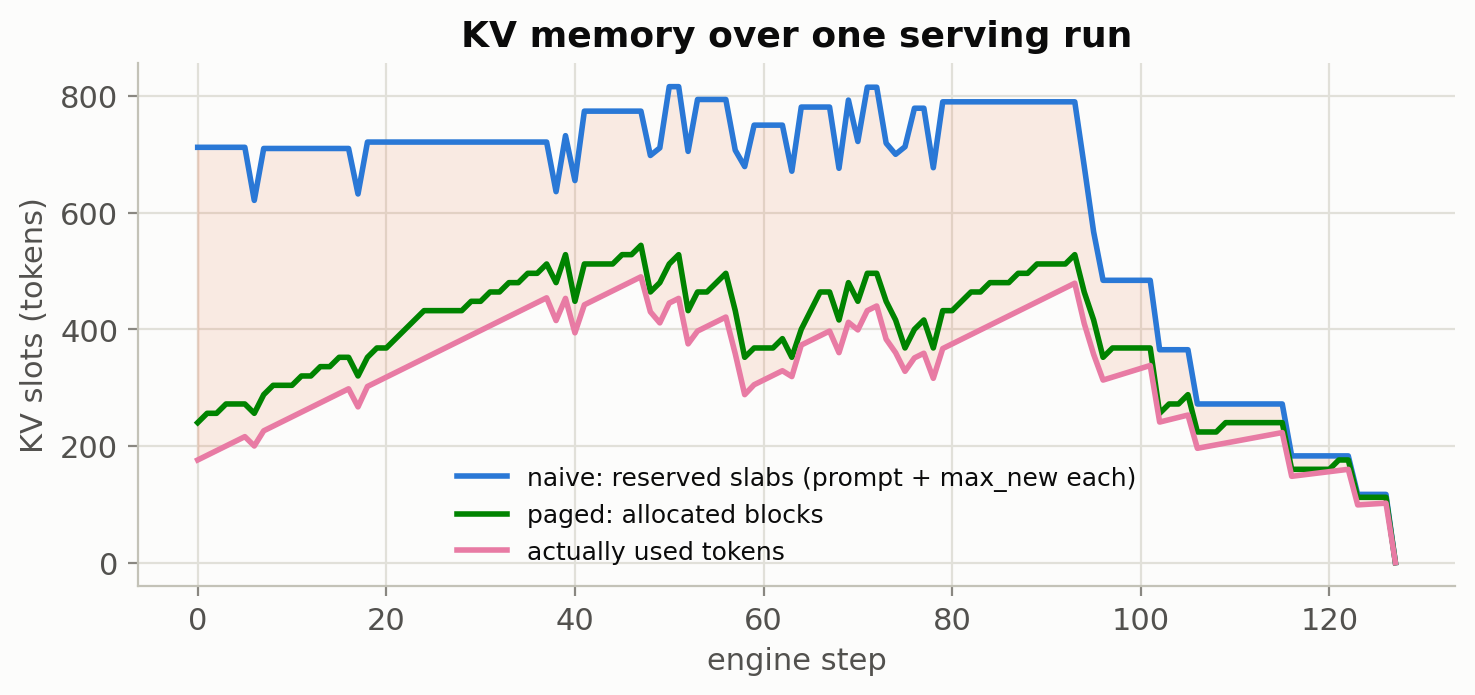
Run the workload and account for every slot, every step. “Naive reserved” is what a slab-per-request server would hold for the same running batch; “allocated” is what the paged pool actually owns; “used” is slots holding real tokens:

Show plotting code
engine = MiniVLLM(num_blocks=96, max_batch=8, continuous=True)
engine.submit(make_workload())
engine.run()
h = np.array(engine.history, dtype=float)

fig, ax = plt.subplots(figsize=(8.5, 3.4))
ax.plot(h[:, 1], label='naive: reserved slabs (prompt + max_new each)')
ax.plot(h[:, 2], label='paged: allocated blocks')
ax.plot(h[:, 3], label='actually used tokens')
ax.fill_between(range(len(h)), h[:, 3], h[:, 1], alpha=0.12, color='C5')
ax.set_xlabel('engine step')
ax.set_ylabel('KV slots (tokens)')
ax.set_title('KV memory over one serving run')
ax.legend(fontsize=9)
plt.show()

waste_naive = 1 - h[:, 3].sum() / h[:, 1].sum()
waste_paged = 1 - h[:, 3].sum() / h[:, 2].sum()
print(f'wasted KV memory — naive slabs: {waste_naive:.0%}   paged blocks: {waste_paged:.0%}')

wasted KV memory — naive slabs: 48%   paged blocks: 13%

The paged line hugs actual usage (the gap is only block-tail fragmentation, bounded by 15 tokens per sequence); the naive line reserves the worst case whether it’s ever needed or not. This gap is capacity: every wasted slot is a request that couldn’t be admitted — which is exactly where vLLM’s throughput multiple comes from.

7. Static vs continuous batching

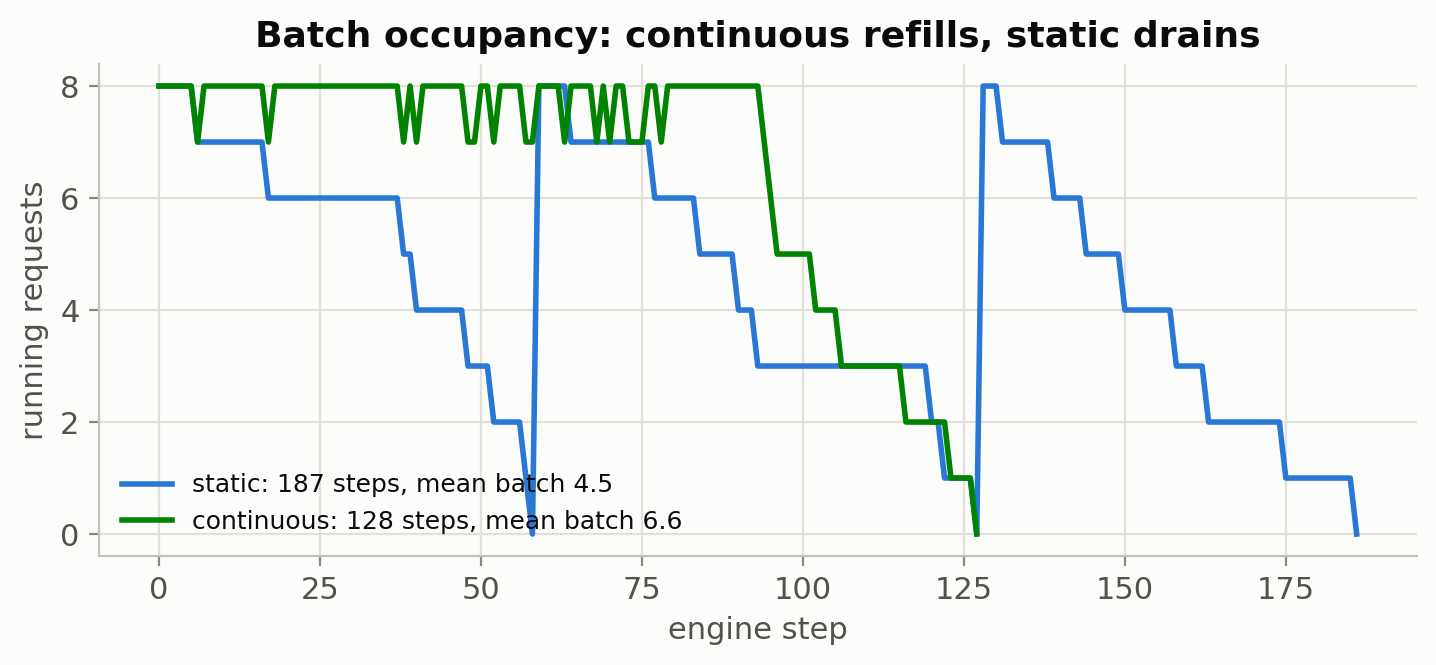
Same workload, same pool, same max_batch — only the admission policy differs. On real hardware a decode step costs roughly the same whether the batch has 2 or 8 sequences (decode is memory-bound on streaming the weights — see CUDA Basics §8), so engine steps ≈ time, and occupancy is the whole game:

Show plotting code
runs = {}
for mode, cont in [('static', False), ('continuous', True)]:
    eng = MiniVLLM(num_blocks=96, max_batch=8, continuous=cont)
    eng.submit(make_workload())
    t0 = time.perf_counter()
    eng.run()
    runs[mode] = (eng, time.perf_counter() - t0)

fig, ax = plt.subplots(figsize=(8.5, 3.2))
for mode, (eng, _) in runs.items():
    occ = [s[0] for s in eng.history]
    ax.plot(occ, label=f'{mode}: {len(occ)} steps, mean batch {np.mean(occ):.1f}')
ax.set_xlabel('engine step')
ax.set_ylabel('running requests')
ax.set_title('Batch occupancy: continuous refills, static drains')
ax.legend(fontsize=9)
plt.show()

s_steps = len(runs['static'][0].history)
c_steps = len(runs['continuous'][0].history)
total_tokens = sum(len(r.out) for r in runs['continuous'][0].done)
print(f'{total_tokens} tokens generated either way')
print(f'static:     {s_steps} steps  (wall {runs["static"][1]:.2f}s on CPU)')
print(f'continuous: {c_steps} steps  (wall {runs["continuous"][1]:.2f}s on CPU)')
print(f'-> {s_steps / c_steps:.2f}x fewer decode steps with continuous batching')

891 tokens generated either way
static:     187 steps  (wall 0.88s on CPU)
continuous: 128 steps  (wall 0.85s on CPU)
-> 1.46x fewer decode steps with continuous batching

The static engine’s sawtooth is the classic pathology: each batch drains to a single straggler before the next can start. Continuous batching holds occupancy near the cap the whole run. (CPU wall-clock understates the win because our per-step cost does grow with batch size — on a GPU it barely does, which is the point.)

8. Preemption: when the pool runs dry

Shrink the pool until requests genuinely don’t fit. The scheduler guarantees every step can complete by evicting the youngest request — freeing its blocks and requeueing it with its generated tokens folded into the prompt for later recomputation (vLLM’s recompute-preemption policy):

Code
eng = MiniVLLM(num_blocks=24, max_batch=8, continuous=True)  # deliberately starved
eng.submit(make_workload())
eng.run()
assert all(len(r.out) >= r.stop_after for r in eng.done) and len(eng.done) == 24
print(f'all 24 requests completed despite a {24 * BLOCK}-token pool; '
      f'{eng.preemptions} preemption(s) along the way')
all 24 requests completed despite a 384-token pool; 16 preemption(s) along the way

🏗️ Project milestone M13 — the finale: serve your model

Everything converges here. Load checkpoints/myllm/final.pt (M7) and serve it through this chapter’s engine:

  1. Adapt the decode path: MiniLayer maps 1:1 onto the repo Transformer’s weights (q/k/v/o projections, SwiGLU, RMSNorms) — either load the state_dict into MiniModel-style modules at your config’s sizes, or generalize prefill/decode_step to take the layer objects from your checkpointed model.
  2. Prove it: the chapter’s correctness assert (paged tokens == full-recompute reference, 3 prompts x 20 greedy tokens) must pass on your weights.
  3. Serve it: 16 requests through continuous batching with a pool small enough to force at least one preemption; then decode the first request’s output with your tokenizer and print your model’s text — plus the accumulated metrics.json, the paper trail of how it got here.

Accept when: the assert passes and you’re reading text generated by your own LLM through your own paged inference engine. That’s the book. Part of The Project: Serve Your Own LLM.

Sessions S4.3–S4.6 split the finale into M13a–d, built in checkpoints/myllm/src/serve_myllm.py (load_model, greedy_paged / greedy_reference, serve) so the milestone tests can import your engine; S4.6 records metrics.json['m13_finale']. Verify: uv run pytest tests/milestones/.

Key Takeaways

  1. The KV cache is the serving bottleneck — ~512 KB/token for a 7B model means the cache, not the weights, decides batch size.
  2. Paging turns worst-case reservation into on-demand allocation. Waste drops from the naive slab’s near-half share (48% measured above) to block-tail fragmentation only — 13% here because our toy sequences are short relative to the 16-token block; at realistic sequence lengths it falls below 4%.
  3. PagedAttention is a gather, not new math — attention over block-table-ordered K/V is bit-identical to contiguous attention (we asserted it), which is why vLLM needs no model changes.
  4. Continuous batching keeps the batch full. Same tokens, 1.46x fewer decode steps here — and on memory-bound GPU decode, steps are time.
  5. Preemption makes overcommit safe: evict-and-recompute trades compute for memory and never deadlocks — the same bet as OS swapping.
  6. What real vLLM adds beyond this mini version: fused paged-attention CUDA kernels, prefix sharing with copy-on-write blocks, chunked prefill, and multi-GPU — the concepts are the ones above.

🔨 From-scratch project: p3 — A KV-cached decoder from a blank file

M13 had you adapt this chapter’s engine to your weights. The from-scratch project removes the engine: you get a small fully-documented model with no cache hooks at all, and build full-recompute greedy, KV-cached greedy (held to the same token-for-token parity assert you just earned), and top-p sampling — from nothing. A good retention check a week after the finale.

Brief and rules: projects/p3_kv_serve/README.md

uv run pytest projects/p3_kv_serve/ -v