A SIMT Simulator From Scratch: Watch Your Kernel’s Memory Traffic
CUDA Basics explained the execution model in prose and diagrams. This chapter makes it executable without a GPU: a pure-Python + NumPy simulator (src/ai_playground/gpusim/, ~350 lines) that runs numba.cuda-style kernels and logs every memory access — so instead of being told “strided access is 32x slower,” you count the transactions yourself.
Because it has no native dependencies, this is also the one chapter that can run anywhere Python runs — including Pyodide in a browser.
Concepts covered
#
Concept
Section
1
Launching kernels: grid, block, thread indexing
§1
2
How barriers force the generator design
§2
3
Barrier divergence — a real bug class, caught
§3
4
Coalescing, visualized per warp
§4
5
Shared-memory bank conflicts
§5
6
Tiled matmul: why shared memory cuts global traffic ~TILE×
Make the CUDA execution model executable without a GPU — and count memory transactions instead of taking them on faith.
🏗️ Chapter milestone: M10 — write and verify the paged-gather access pattern your engine relies on — the exercise at the end of this chapter; see The Project.
Tip⏱️ Sessions S5.3–S5.4
Two sessions: S5.3 runs the simulator; S5.4 is 🏗️ M10 — the paged gather, verified. Cards, prerequisites, and done-when tests: the Session Guide.
No GPU needed anywhere in this notebook — the simulator is pure Python + NumPy.
Setup
# Setup — works from a repo checkout (via ../src) or standalone on Colabimport syssys.path.insert(0, '../src')try:import ai_playground # noqa: F401exceptImportError:%pip install -q git+https://github.com/ggreg/ai_playground.git%config InlineBackend.figure_format ='retina'from ai_playground.plotting import apply_plot_styleapply_plot_style()
1. The simulator in sixty seconds
A kernel is a function taking ctx (this thread’s identity: threadIdx, blockIdx, blockDim, gridDim) plus your arrays. Launch syntax mirrors CUDA’s <<<grid, block>>>. The launch returns a LaunchReport holding the full access log — real CUDA returns nothing, but inspecting the traffic is the whole point of simulating.
Code
import numpy as npfrom ai_playground.gpusim import kernel, coalescing_report, total_transactions@kerneldef vector_add(ctx, a, b, c): i = ctx.grid(1) # blockIdx.x * blockDim.x + threadIdx.xif i < a.size: c[i] = a[i] + b[i]rng = np.random.default_rng(42)a, b = rng.standard_normal(200).astype(np.float32), rng.standard_normal(200).astype(np.float32)c = np.zeros(200, dtype=np.float32)report = vector_add[7, 32](a, b, c) # 7 blocks x 32 threads = 224 threads for 200 elementsassert np.allclose(c, a + b)print('correct:', np.allclose(c, a + b))print(report)
The guard if i < a.size is the classic CUDA idiom: we launched 224 threads for 200 elements, so the last 24 threads must do nothing. Exactly this kernel — same indexing, same guard — runs for real in CUDA Basics §6 under Numba.
2. Barriers are the hard part — and why kernels become generators
syncthreads() means every thread in the block reaches the barrier before any continues. So threads must be suspendable mid-kernel. Real GPUs do this in hardware; numba’s simulator uses one OS thread per CUDA thread (impossible in WebAssembly — no threads). Here, kernels with barriers are generators: yield ctx.syncthreads() suspends the thread, the scheduler advances everyone to the barrier, verifies they’re at the same one, and resumes.
The visible yield is honest: it marks exactly where your thread stops and waits.
Code
@kerneldef block_reverse(ctx, x, out):"""Reverse each block's segment via shared memory — needs one barrier.""" tile = ctx.shared((32,), np.float32) i, t = ctx.grid(1), ctx.threadIdx.x tile[t] = x[i] # stage into shared memoryyield ctx.syncthreads() # everyone's element must land before... out[i] = tile[31- t] # ...anyone reads a neighbor's slotx = np.arange(64, dtype=np.float32)out = np.zeros_like(x)block_reverse[2, 32](x, out)print('in :', x[:8], '...')print('out:', out[:8], '... (each 32-block reversed)')assert np.allclose(out[:32], x[31::-1]) and np.allclose(out[32:], x[:31:-1])
3. Barrier divergence: the bug the simulator refuses to run
Put a syncthreads() where only some threads reach it and real hardware gives you undefined behavior — pre-Volta GPUs simply hang. The simulator turns both variants into loud errors:
Code
from ai_playground.gpusim import BarrierDivergenceError@kerneldef early_exit(ctx, x):if ctx.threadIdx.x ==0:return# thread 0 leaves... x[ctx.threadIdx.x] =1.0yield ctx.syncthreads() # ...while 31 threads wait for it forevertry: early_exit[1, 32](np.zeros(32, dtype=np.float32))except BarrierDivergenceError as e:print('caught:', e)
caught: threads [0] exited while 31 thread(s) wait at a barrier — on real hardware this hangs or is undefined behavior
4. Coalescing, finally visible
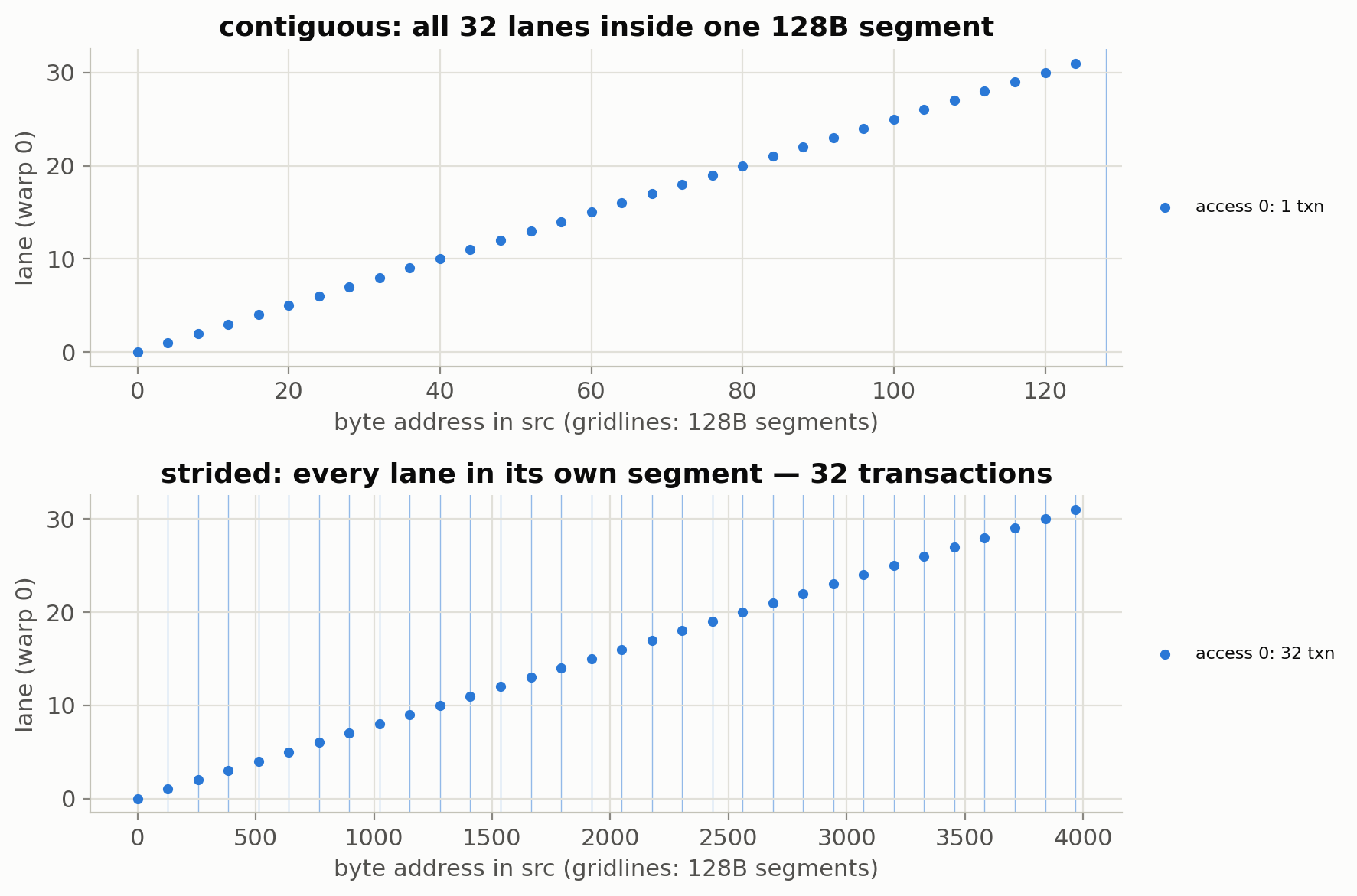
A warp’s 32 loads are serviced in 128-byte transactions. 32 consecutive fp32 values fit in exactly one; a stride of 32 elements (128 bytes) puts every lane in its own segment — 32 transactions to deliver the same useful bytes, i.e. ~1/32 of effective bandwidth.
CUDA Basics §7measured this cost on real hardware. Now we count it:
Code
from ai_playground.gpusim import plot_warp_accesses@kerneldef copy_contiguous(ctx, src, dst): i = ctx.grid(1) dst[i] = src[i] # lane k reads element k: one segment@kerneldef copy_strided(ctx, src, dst): i = ctx.grid(1) dst[i] = src[32* i] # lane k reads element 32k: 32 segmentsn =32src = np.zeros(32* n, dtype=np.float32)r1 = copy_contiguous[1, n](src, np.zeros(n, dtype=np.float32))r2 = copy_strided[1, n](src, np.zeros(n, dtype=np.float32))for name, r in [('contiguous', r1), ('strided', r2)]: reads = [g for g in coalescing_report(r.log) if g.array =='src']print(f'{name:11s}: {reads[0].transactions:2d} transactions 'f'(ideal {reads[0].ideal}) for one warp read')
contiguous :  1 transactions (ideal 1) for one warp read
strided    : 32 transactions (ideal 1) for one warp read
Show plotting code
import matplotlib.pyplot as pltfig, axes = plt.subplots(2, 1, figsize=(9, 6))plot_warp_accesses(r1.log, 'src', ax=axes[0])axes[0].set_title('contiguous: all 32 lanes inside one 128B segment')plot_warp_accesses(r2.log, 'src', ax=axes[1])axes[1].set_title('strided: every lane in its own segment — 32 transactions')plt.tight_layout()plt.show()
Same 32 elements delivered, 32x the memory transactions. This is takeaway #6 from CUDA Basics — “coalesce or die” — as an actual count rather than a slogan.
5. Shared-memory bank conflicts
Shared memory has 32 banks of 4 bytes. Lanes hitting distinct addresses in the same bank serialize; lanes reading the same address broadcast for free. A stride-2 fp32 access maps two lanes to each bank — a 2-way conflict, half the shared-memory bandwidth:
Code
from ai_playground.gpusim import bank_conflict_report@kerneldef shared_strides(ctx, out): s = ctx.shared((64,), np.float32) lane = ctx.threadIdx.x s[lane] =float(lane) # write, stride 1: conflict-freeyield ctx.syncthreads() out[lane] = s[(2* lane) %64] # read, stride 2: 2-way conflictreport = shared_strides[1, 32](np.zeros(32, dtype=np.float32))for g in bank_conflict_report(report.log): label ='conflict-free'if g.transactions ==1elsef'{g.transactions}-way conflict'print(f'{g.array}{g.kind}: {label}')
6. The payoff: tiled matmul cuts global traffic by TILE×
The naive matmul reads every element of A and Bn times — once per output element that needs it. The tiled version stages TILE×TILE blocks through shared memory so each global element is read only n/TILE times. This reuse — not raw FLOPs — is why every fast matmul (and FlashAttention) is built around shared memory. Count it:
Code
TILE =8@kerneldef naive_matmul(ctx, A, B, C): col, row = ctx.grid(2)if row < C.shape[0] and col < C.shape[1]: acc =0.0for k inrange(A.shape[1]): acc += A[row, k] * B[k, col] C[row, col] = acc@kerneldef tiled_matmul(ctx, A, B, C): tile_a = ctx.shared((TILE, TILE)) tile_b = ctx.shared((TILE, TILE)) tx, ty = ctx.threadIdx.x, ctx.threadIdx.y col = ctx.blockIdx.x * TILE + tx row = ctx.blockIdx.y * TILE + ty acc =0.0for k0 inrange(0, A.shape[1], TILE): tile_a[ty, tx] = A[row, k0 + tx] # each global element loaded once per tile tile_b[ty, tx] = B[k0 + ty, col]yield ctx.syncthreads() # tiles fully staged...for k inrange(TILE): acc += tile_a[ty, k] * tile_b[k, tx] # ...then TILE reuses from sharedyield ctx.syncthreads() # done reading before next overwrite C[row, col] = accn =32A = rng.standard_normal((n, n)).astype(np.float32)B = rng.standard_normal((n, n)).astype(np.float32)C1 = np.zeros((n, n), dtype=np.float32)r_naive = naive_matmul[(n // TILE, n // TILE), (TILE, TILE)](A, B, C1)C2 = np.zeros((n, n), dtype=np.float32)r_tiled = tiled_matmul[(n // TILE, n // TILE), (TILE, TILE)](A, B, C2)assert np.allclose(C1, A @ B, rtol=1e-4) and np.allclose(C2, A @ B, rtol=1e-4)t_naive, _ = total_transactions(coalescing_report(r_naive.log))t_tiled, _ = total_transactions(coalescing_report(r_tiled.log))print(f'both correct. global memory transactions: naive={t_naive}, tiled={t_tiled}')print(f'tiling cut global traffic {t_naive / t_tiled:.1f}x (theory: ~TILE = {TILE}x)')
both correct. global memory transactions: naive=5248, tiled=1152
tiling cut global traffic 4.6x  (theory: ~TILE = 8x)
🏗️ Project milestone M10 — the paged gather, on the simulator
M13’s engine reads KV through a block table. Write that access pattern as a simulator kernel: paged_gather(ctx, pool, table, out) where each thread copies one element of one token-row from its physical block into contiguous output. Verify against np fancy-indexing, then run coalescing_report: is reading through a block table coalesced? (It should be — tokens are contiguous within a block, so transactions stay near ideal for 16-token blocks.)
Accept when: the kernel matches the reference and you can state the measured transactions-vs-ideal ratio for your block size. Part of The Project: Serve Your Own LLM.
Session S5.4 — record m10_coalescing = {'block_size': …, 'transactions_ratio': …} in metrics.json; verify: uv run pytest tests/milestones/test_m10_paged_gather.py.
Tiling cut transactions 4.6x — real, but short of the 8x the element-count argument promises. The gap is instructive: in element terms the naive kernel does read each value n times vs n/TILE (the full 8x), but at the transaction level it was already getting help — all 8 lanes sharing a ty read the sameA[row, k] address, and a warp services identical addresses with one broadcast transaction. Counting transactions instead of accesses is exactly the correction real hardware applies to naive intuition, and it’s why profilers report transactions, not loads. On real hardware this reuse is still the difference between a bandwidth-bound kernel and a compute-bound one — the SGEMM chapter plays this same trick with real CUDA and pushes it to cuBLAS-level performance.
Key Takeaways
CUDA’s model is small enough to build yourself — grid/block/thread indexing, shared memory, and barriers fit in ~200 lines of Python. If you can implement it, you understand it.
Barriers are the essence of block cooperation. The generator design makes the suspension point visible — and barrier divergence becomes a caught error instead of a hung GPU.
Coalescing is countable. One warp read = 1 transaction if contiguous, up to 32 if strided. The simulator’s plots show the exact segments each lane touches.
Shared memory is a reuse mechanism, not a cache. Tiling cut global transactions 4.6x here (and element reads by the full TILE=8x) while producing identical results — the insight behind fast GEMMs and FlashAttention (Dao et al., 2022).
Semantics simulate; performance doesn’t. The simulator counts what hardware would do — for real timings, open CUDA Basics or the SGEMM chapter on a GPU.
Pure Python + NumPy means it runs anywhere — including Pyodide in a browser tab, where real CUDA (and even Numba’s own simulator, which needs llvmlite) cannot go.
What to read next
Next: 01c_virtual_gpu.ipynb — the same kernels on a cycle-approximate virtual T4, with the die animated.
Then: 02_sgemm_optimization.ipynb — the tiling idea from §6, on real hardware, optimized until it rivals cuBLAS.
The simulator source: src/ai_playground/gpusim/ (core.py for the scheduler, memory.py for the transaction math) — and tests/test_gpusim.py for its contract.